
_Yury Gogotsi
Gogotsi is the Distinguished University and Charles T. and Ruth M. Bach Professor in the College of Engineering and director of the A.J. Drexel Nanomaterials Institute.
Imagine a shirt that keeps you cool in the summer and warm in the winter — without batteries, wires or bulky layers. An international research team led by Drexel has found that thin coatings of MXene nanomaterials can enhance a material’s thermal properties by modulating the passage of infrared radiation, enabling both passive heating and cooling effects.
MXenes, 2D nanomaterials first discovered at Drexel over a decade ago, continue to demonstrate new capabilities, reinforcing their potential as a lightweight, flexible and highly functional nanomaterial. They have already shown promise in energy storage, water desalination and electromagnetic interference. Now, researchers are exploring passive temperature control as yet another potential application for this versatile family of materials.
_Thermal Paint
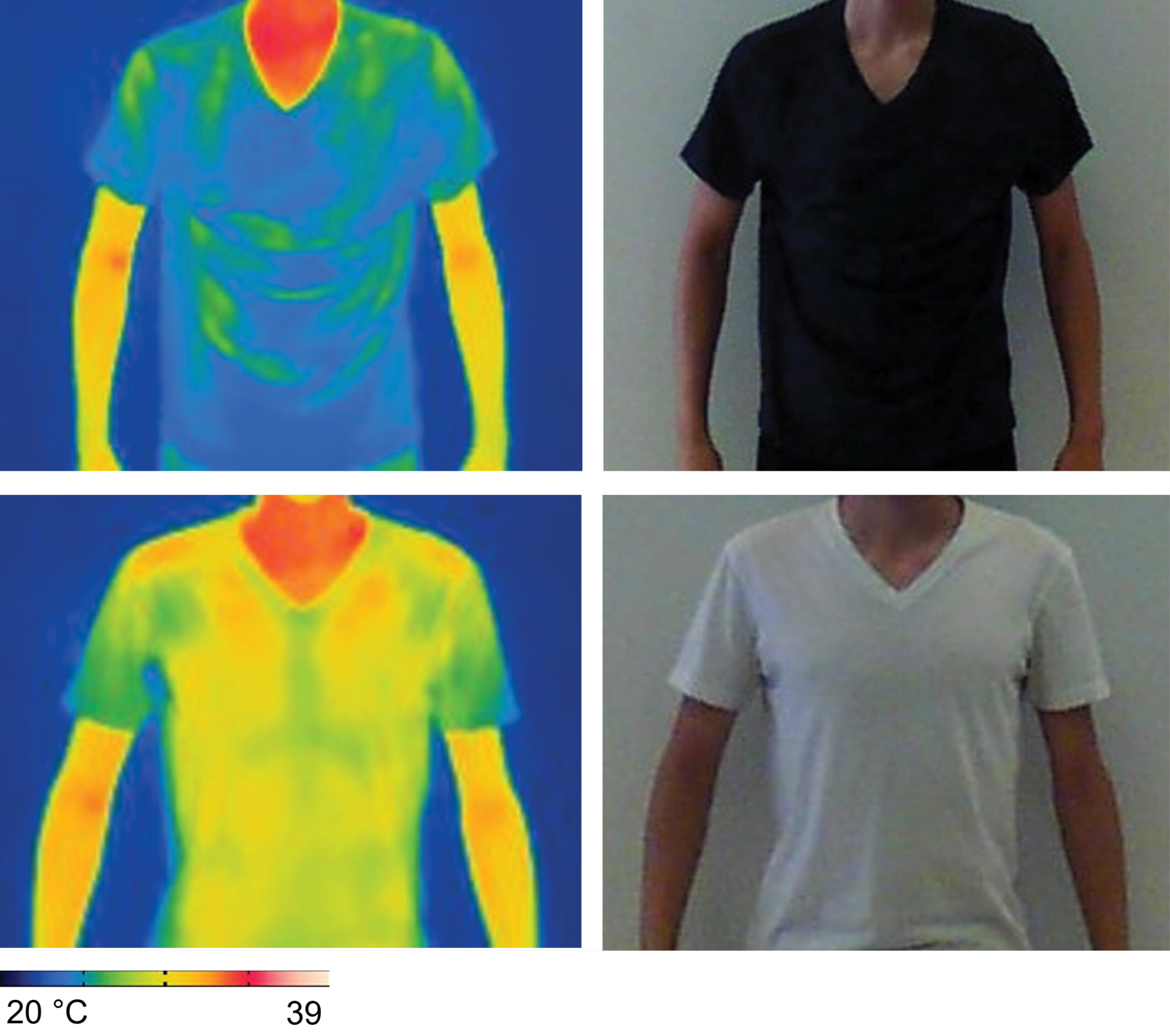
A black shirt treated with a MXene coating is 10–15 degrees cooler compared to an untreated one.
The team tested 10 different MXene coatings on textiles and found that they could modulate infrared radiation to create both heating and cooling effects. When applied for cooling, the nanocoatings reflected external infrared radiation (heat) while allowing body-emitted heat to pass through, keeping the material significantly cooler. At the same time, titanium carbide MXene can block dangerous ultraviolet and heat-generating infrared radiation.
A treated black shirt, for instance, could be 10 to 15 degrees cooler than an untreated fabric. Beyond clothing, MXenes’ infrared-blocking properties could also have applications in thermal camouflage or infrared-readable radio frequency identification.
And because a MXene coating is a thousand times thinner than a human hair, thin films could be applied not only to clothing but potentially also to building surfaces, saving energy and lowering heating and cooling costs.
“MXene coatings could find applications in both localized thermal management and large-scale radiative heating and cooling systems,” says Yury Gogotsi, Distinguished University and Charles T. and Ruth M. Bach Professor in the College of Engineering. “There are significant advantages with passive infrared heating/cooling over traditional active systems requiring electrical power.”