
_Naoko Kurahashi Neilson
Neilson is an assistant professor in the Department of Physics of the College of Arts and Sciences and a member of the IceCube collaboration, a high-energy neutrino telescope operating at the geographic South Pole.
Drexel physicists and their international colleagues relied on minute particles of matter to produce a dazzling, wholly new way of imaging the Milky Way.
Spearheaded by Naoko Kurahashi Neilson, a professor of physics in the College of Arts and Sciences, a research team assembled a portrait of the galaxy informed by neutrinos — subatomic particles — detected from the IceCube Neutrino Observatory at the National Science Foundation’s Amundsen-Scott South Pole Station.
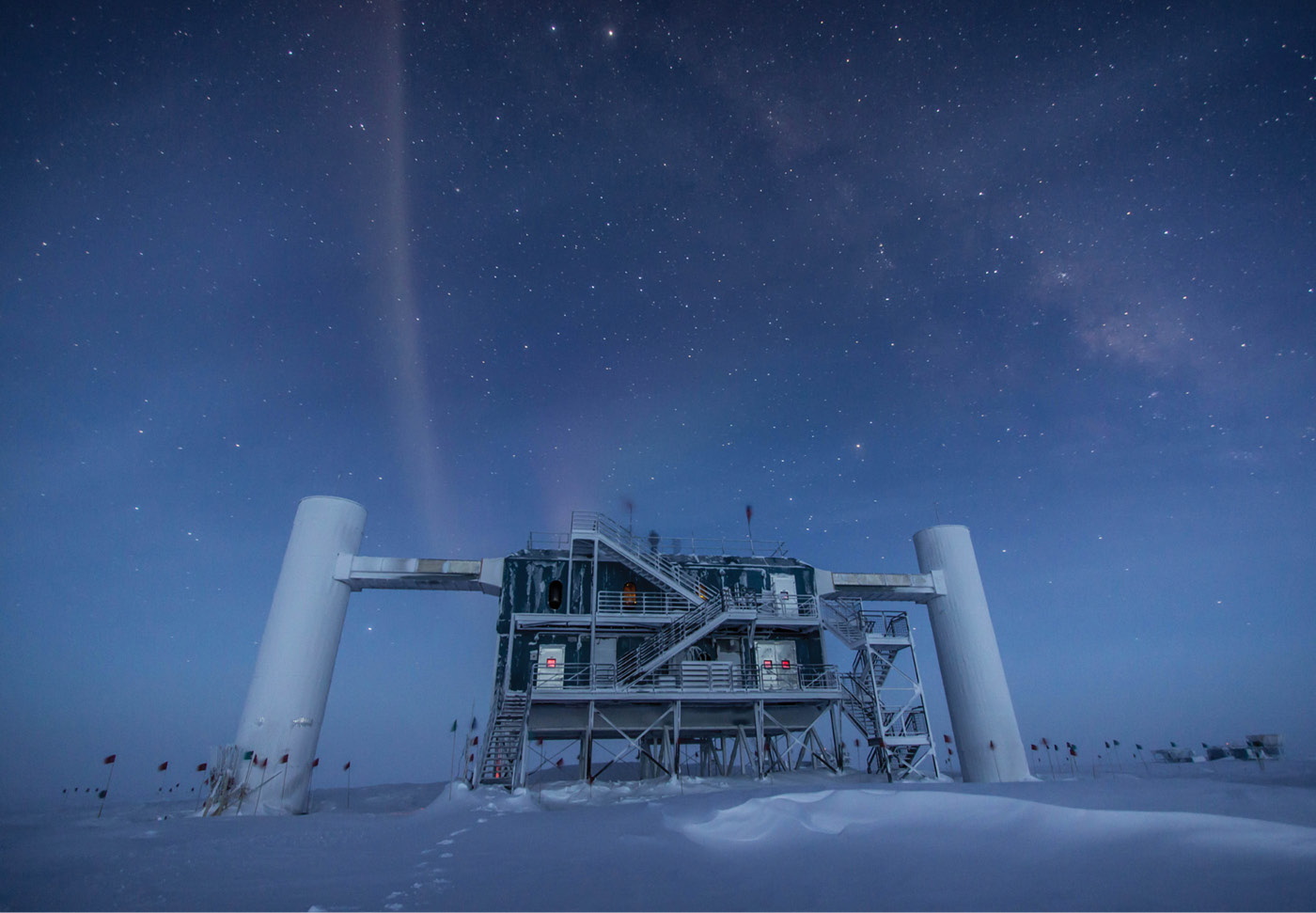
_Polar position
The IceCube Neutrino Observatory uses thousands of light sensors buried within the Antarctic ice at the South Pole. The sensors detect faint patterns of light emitted when neutrinos pass through ice molecules and produce charged particles. ICECUBE PHOTOS COURTESY OF ICECUBE COLLABORATION/U.S. NATIONAL SCIENCE FOUNDATION (LILY LE & SHAWN JOHNSON)/ESO (S. BRUNIER)
Previously, images of the galaxy captured by astronomers were based on electromagnetic energy.
“We use neutrinos to study the universe, in a way that we can’t do by studying light,” Kurahashi Neilson says.
The nearly imperceptible “ghost particles” can be observed by the mammoth IceCube Neutrino Observatory, using thousands of light sensors in a network buried deep within a cubic kilometer of glacial ice at the South Pole on Antarctica.
The observatory detects interactions of the neutrinos beneath the ice as faint patterns of light.
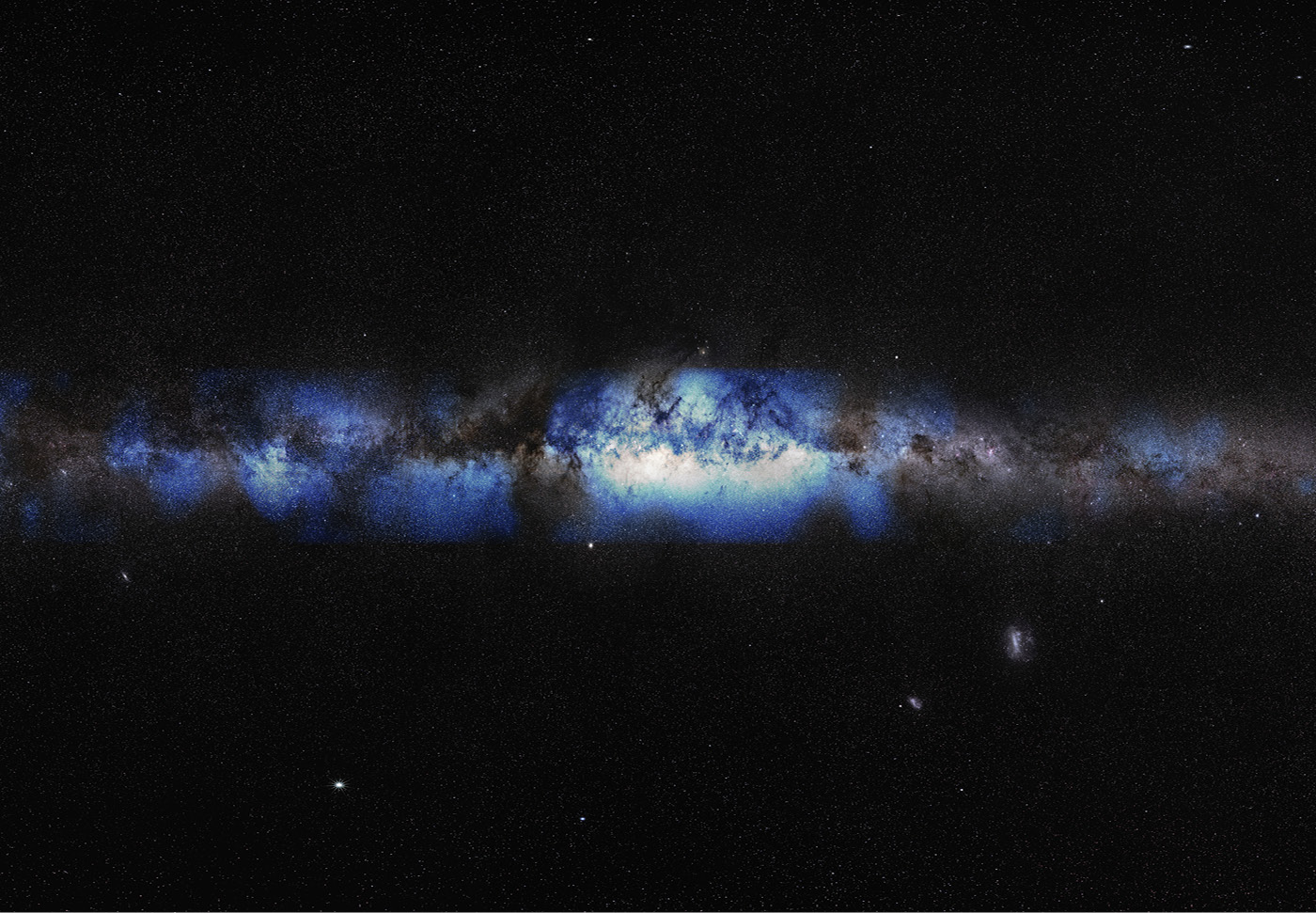
_View of the Cosmos
In the Milky Way Galaxy, cosmic rays interact with galactic gas and dust to produce both gamma rays and subatomic particles called neutrinos. The IceCube team captured this first-of-its-kind image of the Milky Way Galaxy by detecting these tiny particles of matter.
These patterns sometimes point to a particular area of the sky, allowing the researchers to determine the neutrinos’ source.
After receiving an NSF Faculty Early Career Development grant, Kurahashi Neilson and former Drexel post-doctoral researcher Michael Richman proposed an innovative computational analysis — using new machine learning techniques and developing better methods to filter data — to generate the image.
Former doctoral student Steve Sclafani then developed an algorithm that compared the relative position, size and energy of more than 60,000 such neutrino-generated cascades of light recorded by IceCube over 10 years.
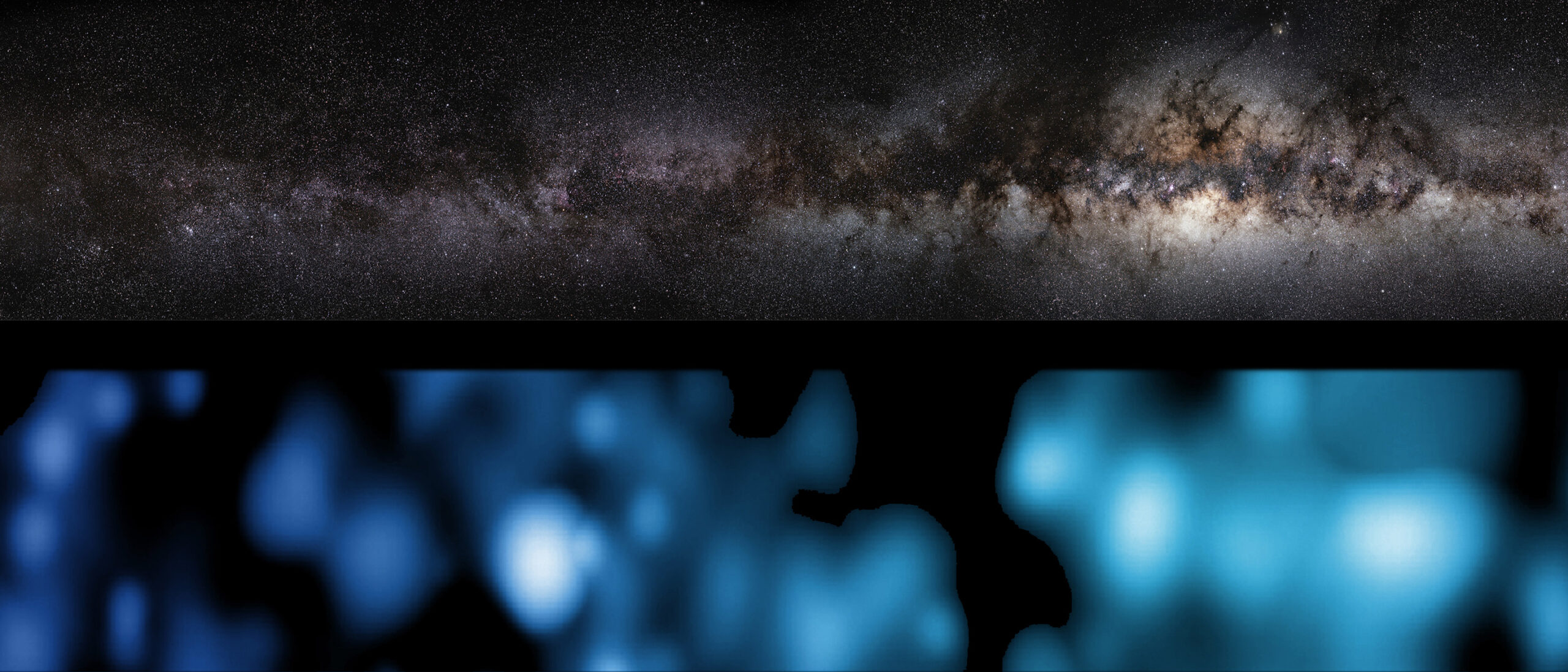
Milky Way depicted with visible light (top)…and with neutrinos (bottom).
After testing and verifying the algorithm, the research team input IceCube-generated data from neutrinos determined to be from the southern sky — where they expected most neutrino emissions from the galactic plane to originate. They then compared the results to previously published “prediction maps” of locations in the sky where neutrinos from the Milky Way are expected to shine.
Using the real IceCube data in the algorithm produced an image showing bright spots corresponding to locations in the Milky Way.
Kurahashi Neilson predicts this process will ultimately help reveal other unknown aspects of the universe.
“Observing our own galaxy for the first time, using particles instead of light, is a huge step,” she says. “As neutrino astronomy evolves, we will get a new lens with which to observe the universe.”