
_ABIGAIL TETTEH
Tetteh is a doctoral candidate in the School of Biomedical Engineering, Science and Health Systems.
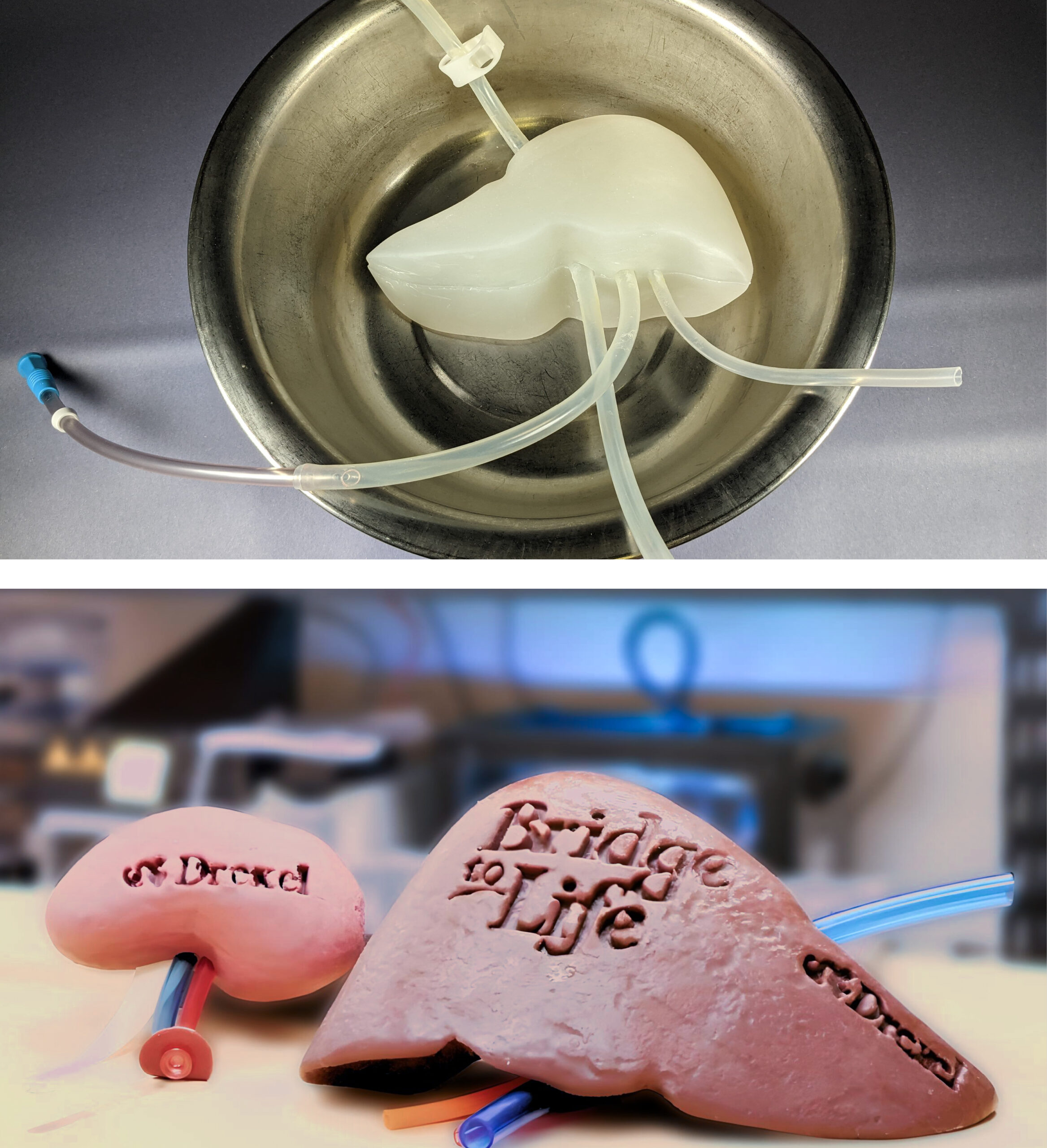
When surgeons train for complex organ transplants, the closest they get to the real thing is, well, the real thing. But human and animal organs are difficult to obtain, so a team of Drexel biomedical engineering students created the next best option: lifelike organs that mimic the look, feel and density of human livers and kidneys — made of silicone cast in 3D-printed molds.
The project was part of a research collaboration between Drexel, Illinois-based organ transplant medical device maker Bridge to Life, and the Philadelphia-based Gift of Life donor program.
Bridge to Life had developed a new organ preservation system that outperformed traditional ice storage methods, but training surgeons on the device required a realistic teaching model.
Drexel students stepped in to provide one.
David J. Reich, former chief of transplantation at Drexel’s College of Medicine and currently a professor of surgery and biomedical engineering, had led the clinical trial of Bridge to Life’s new organ preservation system. To train surgeons on how to use it, he turned to Ken Barbee, senior associate dean at Drexel’s School of Biomedical Engineering, Science and Health Systems, to help develop a realistic teaching model.
_A Life-like Liver
The prototype of the liver (top) as it looked during development and a final model (bottom).
Under their guidance, doctoral student Abigail Tetteh began designing and manufacturing organ replicas with precise color, shape, weight and texture. Then-biomedical engineering major Madison Titlow ’23 joined the project from 2022–2023.
Their research took them to Gift of Life, where they examined real human kidneys to refine their models. The result: 100 highly realistic, 3D-printed organs now being used to train surgeons worldwide.
For the students, the project wasn’t just an academic exercise — it was a career-defining experience. Titlow’s work led to a co-op and a full-time job offer after graduating in 2023, while Tetteh secured a year-long fellowship with the FDA. Another student, biomedical engineering major Caroline Reis, later joined Tetteh to finalize the kidney design and mass-produce kidneys.
“This was more than just a research project,” says Barbee. “It was an opportunity for students to apply their knowledge in a way that directly impacts medical training and patient care.”