
_Garth D. Ehrlich
Ehrlich is a professor of microbiology and immunology and professor of otolaryngology–head and neck surgery in the College of Medicine.
The human body hosts trillions of microbes that help us to keep healthy, but when they shift out of balance, it may contribute to disease — possibly including Alzheimer’s and related dementias.
Researchers analyzing 130 samples from the donated brains of 32 people — 16 with Alzheimer’s and 16 age-matched controls — discovered that the Alzheimer’s brains harbored profoundly different bacterial profiles compared to the healthy brains. The findings suggest that the brain, like the gut, may have its own microbiome that can become imbalanced over time, potentially influencing disease progression.
Their study, published in Frontiers in Cellular and Infection Microbiology, provides new insight into how infections and microbial shifts might play a role in neurodegenerative diseases.
The authors hypothesize that the brain begins with a healthy microbiome, but as the disease develops, the brain’s microbial community shifts.
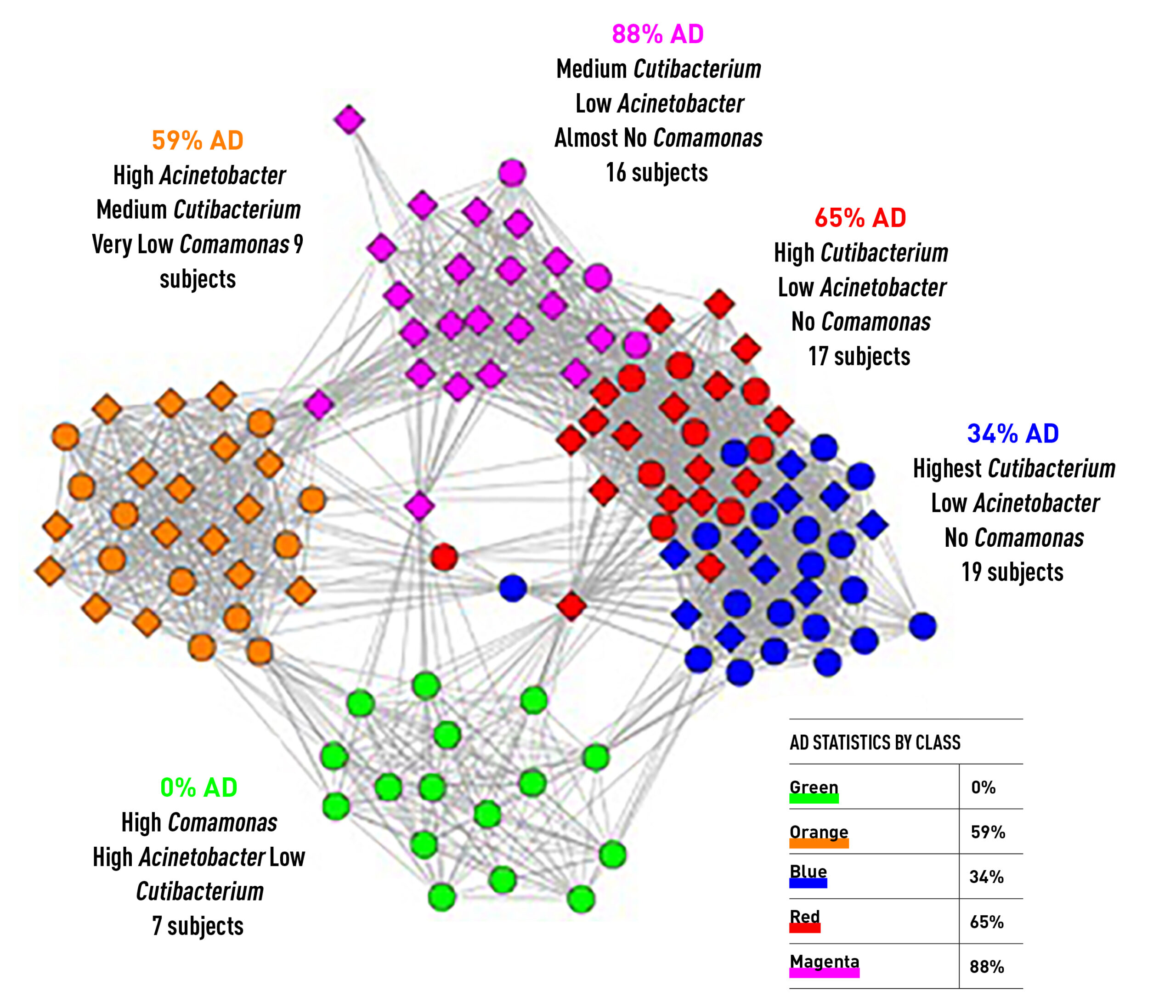
SHIFTING_BIOME
Researchers sampled bacterial populations in the brains of subjects with and without Alzheimer’s. They found that Alzheimer’s brains harbored very different bacterial communities. They were able to track a progression from healthy (green) to diseased brains (magenta) and beyond (red, blue).
It becomes less healthy, with a major increase in the percentage of known pathogenic bacteria, including Cutibacterium acnes — a phenomenon the researchers describe as the emergence of an “Alzheimer’s pathobiome.”
“The development of Alzheimer’s and other dementias is complex and involves the patient’s genetics as well as their lifetime “exposome” which includes environmental toxins and infections,” says senior author Garth D. Ehrlich, a professor of microbiology and immunology, and otolaryngology–head and neck surgery. “I’m a believer in the more infections you get in the brain, whether viral, bacterial, fungal or parasitic, the higher your risk of Alzheimer’s. This pathobiome is not the whole answer, but it’s an important piece of the puzzle.”
Despite many unknowns, the authors said this is a significant step forward for studying the microbiome.
Ehrlich is a founding member of the Alzheimer’s Pathobiome Initiative, a newly formed international group of researchers developing pilot studies that look for infections in dementia and Alzheimer’s patients.