
_MIRA OLSON
Olson is an associate professor in the College of Engineering.

_PATRICK GURIAN
Gurian is a professor in the College of Engineering.
Over the next two decades, people living along the Schuylkill River — including Philadelphia — could face up to 82 more days of water shortages each year due to climate change under current water management approaches, a study warns. In a paper published in Water, Drexel researchers suggest that the watershed may only be able to meet demand about 67% of the time, a drop of 22% from its current reliability, based on projections that account for changes in population, land use and climate.
Reductions in streamflow and groundwater stores would mean less water for drinking, irrigation, transportation, energy, recreation and aquatic ecosystems.
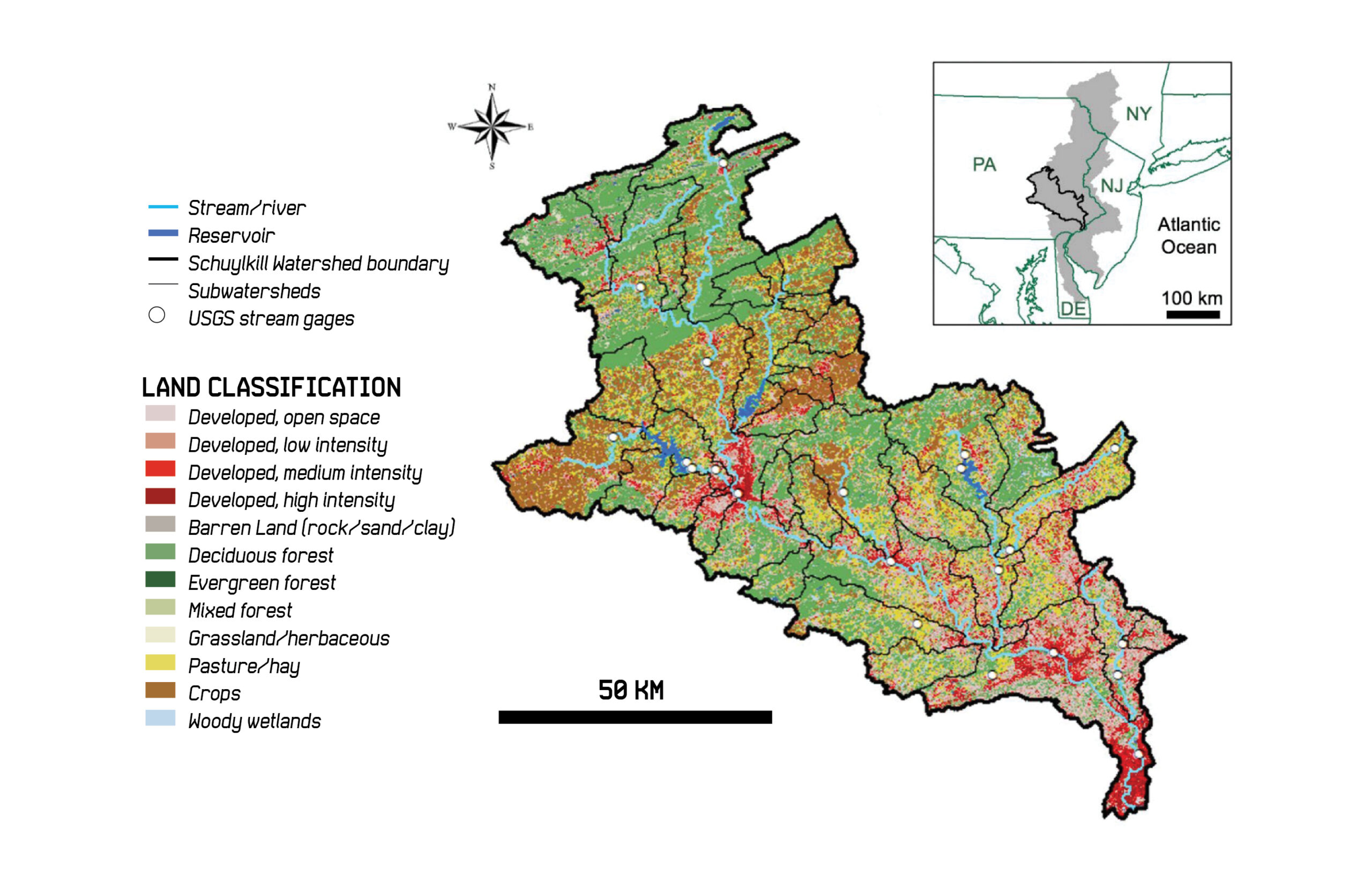
_A Vast Watershed
The Schuylkill River watershed covers 5,180 square kilometers and contains 11 counties, including the city of Philadelphia.
“The gap between available water and demand is expected to require difficult trade-offs,” says Mira Olson, associate professor in the College of Engineering and the study’s principal investigator.
The researchers used data from the U.S. Geological Survey and the World Climate Research Programme to model water availability and then tweaked the inputs to simulate the effects of various climate and population changes.
Their models show that a rise in extreme weather — more storms followed by longer dry periods — will disrupt the natural flow of water into the region’s streams and groundwater reserves.
“Current resource management practices do not account for increases in the number of extreme precipitation events coupled with population growth and a related shift in land cover that will result in more runoff.”
—Mira Olson
Heavy rainfall, instead of replenishing water stores, often runs off too quickly to be captured, and the team predicts that land use shifts may modestly exacerbate the problem. Unfortunately, that, along with less rainfall during warm seasons, is what the Intergovernmental Panel on Climate Change projects for Philadelphia from 2020 to 2040.
The findings underscore the need for proactive water management strategies. The researchers suggest that updating the region’s water models and investment in stormwater infrastructure could help mitigate shortages. More detailed climate and land-use projections could also guide policies to ensure a more resilient water supply.
“To secure the Schuylkill Watershed’s ecosystem services, we must not only adapt our practices but also advocate for collaborative efforts in system and policy adaptation for a more resilient and sustainable future,” says Suna Ekin Kali, a doctoral student at Luleå University in Sweden who contributed to the study.