
_EMILY GRIFFITH
Griffith is a PhD student in the Ecology, Evolution, and Earth Systems program in the College of Arts and Sciences.
A Drexel doctoral student is combining field research, genetics and illustration to uncover the evolutionary secrets of duck plumage — and to make the science accessible. For Emily Griffith, what started as a childhood fascination with birds became a lifelong pursuit of discovery. As a PhD student at Drexel, she is investigating why some male ducks evolve to have dull, female-like plumage instead of the bright colors typically favored by females in the bird species.
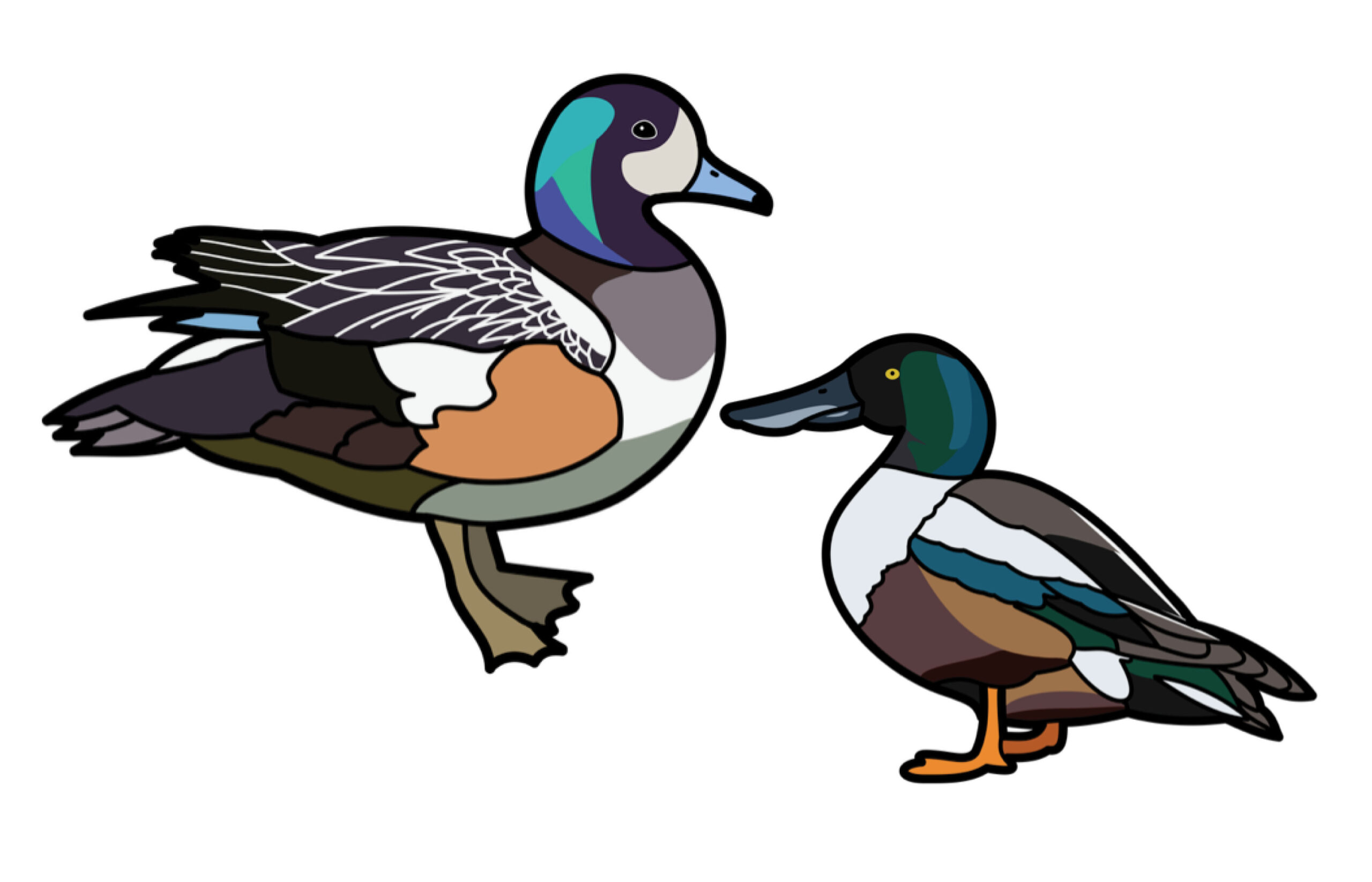
_Fowl and Friend
As a scientist and an artist, Griffth created these illustrations of her research subjects. The male northern shoveler is more colorful than the female, but male and female Chiloe wigeons look more similar.
At the Academy of Natural Sciences of Drexel University, Griffith is analyzing genetic sequences from duck tissue samples to understand the evolutionary forces at play. The Academy’s vast ornithology collection of more than 200,000 specimens offers a rare opportunity to compare species, and Griffith is using these museum specimens to build a phylogeny, or family tree, of all the nearly 180 waterfowl species to answer her questions.
Her research challenges common assumptions about bird evolution. Typically, female birds prefer colorful males, so males evolve brighter plumage.
“Birds are so intrinsically motivating to study — they’re so charismatic. People can relate to them on many levels.”
—Emily Griffith
“But in ducks, it’s the opposite,” Griffith says. “Bright male plumage evolves to become more female-like, or dull. Female birds are typically duller because they sit on the nest, and it serves as better camouflage. We’re finding that males who participate more in caring for their young tend to look more like females.”
Beyond her research, Griffith is passionate about making science more accessible. She chose Drexel for its connection to the Academy, which allows her to work with both scientific collections and the public, and she illustrates her subjects.
“As scientists, our role isn’t just to do science, but to communicate it,” she says.