
_Sean O’Donnell
O’Donnell is a professor in the Department of Biodiversity, Earth and Environmental Science in the College of Arts and Sciences.
A study of army ants in Costa Rica uncovered surprising insights into how the ants survive extreme temperatures. By sampling colonies from across a wide elevation range in Costa Rica, the team discovered that while elevation influenced the ants’ temperature tolerance, the real revelation was the significant variation in thermal tolerances between colonies from the same region.
This challenges the assumption that local adaptation is the sole factor determining how animals cope with temperature extremes, opening the door to new understandings of how climate change impacts animal behavior.
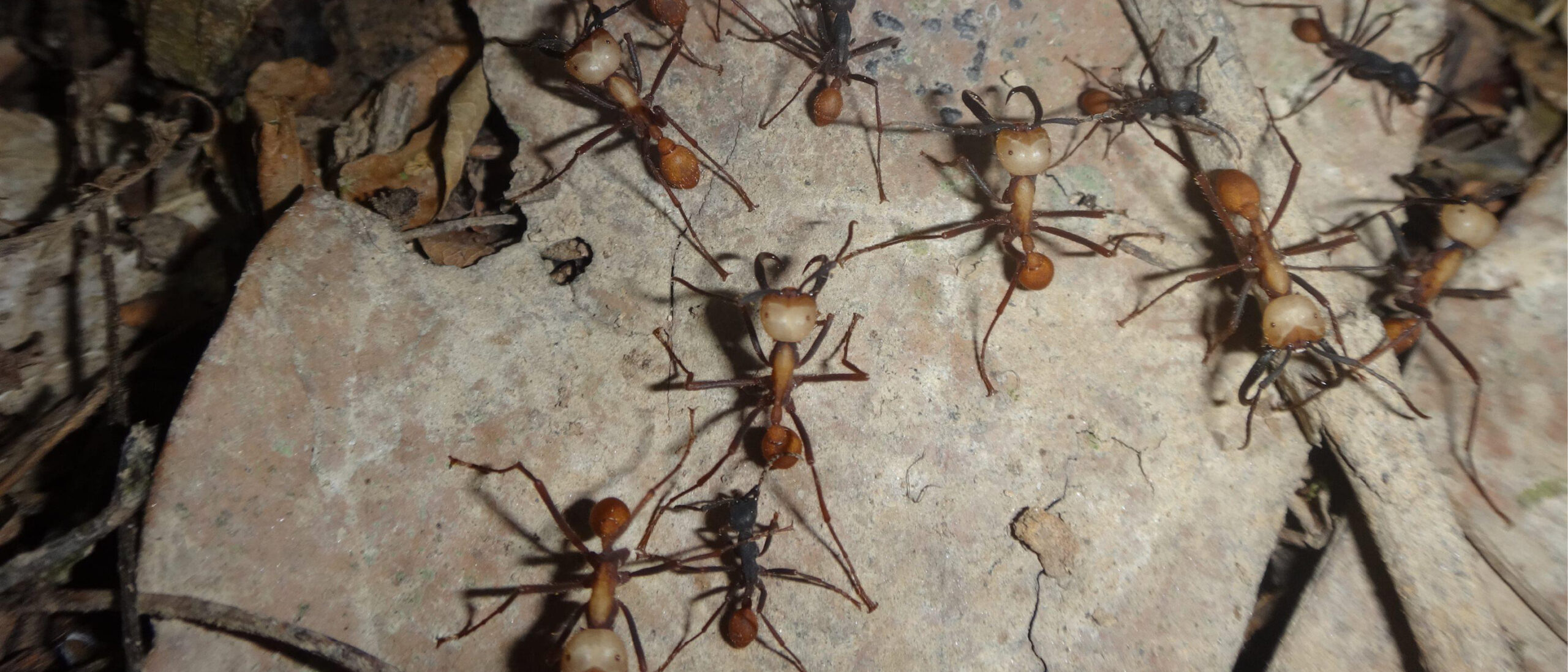
To test how habitat distribution affected their temperature tolerances, Drexel researchers sampled a variety of army ant (Eciton burchellii parvispinum) colonies in northwestern Costa Rica.
_Some Like it Hot (some Don’t)
The neotropical army ant Eciton burchellii parvispinum provides a compelling test case for colony differences in thermal physiology.
“These ants are uniquely exposed to the temperature conditions of their habitat because they are out in the open all the time while they are hunting. Most other ants conduct a large part of their activities underground, which buffers them from the temperature,” says Sean O’Donnell, biologist and professor in Drexel’s College of Arts and Sciences.
O’Donnell and Kaitlin Baudier, a coauthor on the study and assistant professor at the University of Southern Mississippi and former Drexel doctoral student, found three important patterns within their data, recently published in Ecological Entomology.
1) Local Temperature Adaptation: Ant colonies in cooler, higher elevations were more sensitive to heat but better able to survive colder temperatures, showing that local temperature conditions do play a role in how ants cope with temperature.
2) Colony Differences: Different colonies of army ants — which are genetic families — can tolerate different temperature extremes, meaning social groups of animals may react differently to climate change at the same location.
3) Heat and Cold Tolerance Are Separate: Colonies’ tolerance for extreme heat didn’t correlate with tolerance for extreme cold, suggesting that different biological processes govern these two types of temperature resilience.
The team notes that in addition to the physiological characteristics that make the ants a good model to study, these predatory ants are ecologically important to their forest habitats, making them a good benchmark for identifying early climate change effects.
“Larger bodied predator animals will be able to regulate their body temperatures. It’s likely the effects of climate extremes will be stronger on small animals like ants. Temperature changes are already implicated in tropical insect declines,” says O’Donnell.