
_ALEXIS SCHULMAN
Schulman is assistant research professor in the Department of Biodiversity, Earth and Environmental Science in the College of Arts and Sciences.
_AKILAH CHATMAN
Chatman is community science specialist at the Academy of Natural Sciences of Drexel University.
Shouldn’t the people most affected by scientific decisions have a seat at the table?
That question is at the heart of the Academy of Natural Sciences’ Science Shop, a participatory research approach that invites residents to collaborate on the Academy’s scientific priorities, putting people like West Philadelphia resident JoAnn Waters in the center of the process.
Waters, a retiree from the Social Security Administration, had long noticed the prevalence of health problems in her Overbrook Park neighborhood. Childhood asthma seemed almost universal. Lead exposure was common.
But it wasn’t until she attended a meeting at the Overbrook Environmental Education Center organized with Drexel’s Academy of Natural Sciences Science Shop team that she began to understand the full scope of the problem and realized she could play a role in addressing it.
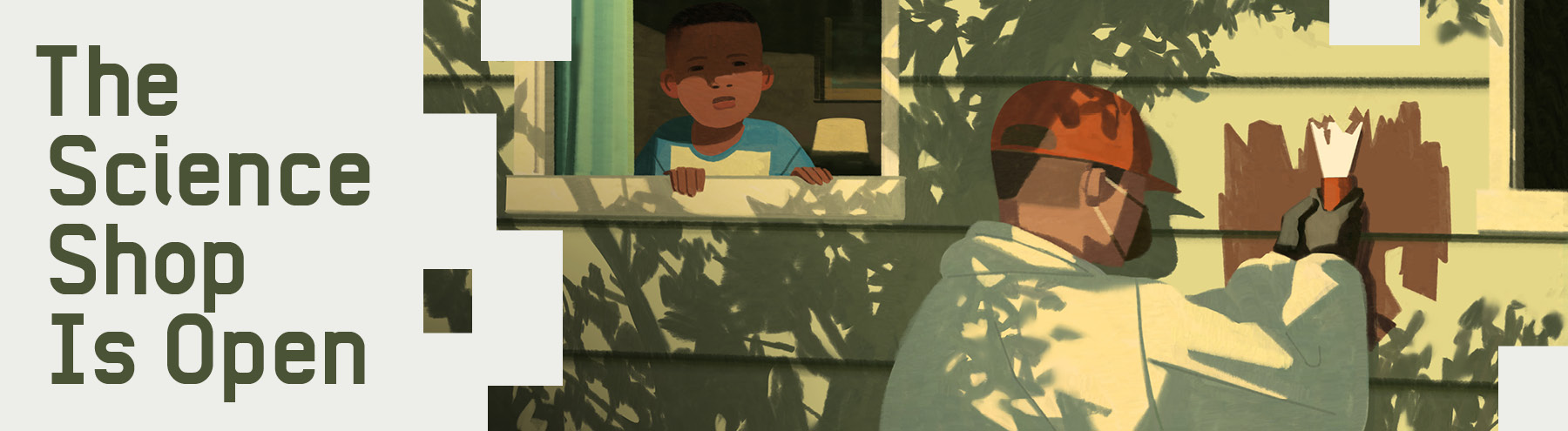
Waters was a community partner in the first Science Shop study of the community’s understanding of lead exposure and safe renovation practices. The study, which was conducted by scientists from the Academy, Overbrook and the University of Pennsylvania with the community’s support, surveyed more than 50 people. The study uncovered a widespread but misplaced belief that drinking water posed more risk of lead poisoning than dust particles released from lead-based paint during renovation or natural aging.
That finding will inform efforts to educate and advocate for universal lead-safe certification among do-it-yourself (DIY) remodelers and contractors — most of whom operate without knowledge of lead’s consequences or of lead abatement regulations.
“If it relates to their well-being, then it makes sense to bring them in as co-researchers, to recognize that they have an invaluable set of expertise that can complement trained scientists’ expertise — and sometimes correct trained scientists’ expertise,” says Alexis Schulman, assistant research professor in the Department of Biodiversity, Earth and Environmental Science in the College of Arts and Sciences and Dolan Fellow for Innovation in Water Science at the Academy of Natural Sciences of Drexel University.
The Academy piloted the Science Shop in 2022 with support from the Institute of Museum and Library Services. It’s a concept modeled on a Dutch academic tradition of community-driven research that dates back to the 1970s and later found adherents throughout Europe. Science shops aren’t a physical place so much as a philosophy — one that involves residents throughout the research process, from framing questions to interpreting data. And it’s especially well suited to environmental justice, where community knowledge is often overlooked despite being essential to understanding local risks.
“Every community impacted by environmental injustices understands its effects. They just can’t describe the effects in terms that line up with the descriptive nature of a scientist.”
—Jerome Shabazz
In Philadelphia, those risks are urgent. Lead exposure is widespread, particularly with residents who reside in the older rowhomes of West and North Philadelphia. In certain ZIP codes of these neighborhoods, 1 in 16 children has tested positive for elevated blood lead level, according to 2022 city data. Many households face compounding threats from aging infrastructure and environmental neglect yet lack the technical, legal and scientific support to compel action.
“Every community impacted by environmental injustices understands its effects,” says Jerome Shabazz, executive director of the Overbrook Environmental Education Center. “They just can’t describe the effects in terms that line up with the descriptive nature of a scientist.”
By elevating local knowledge and partnering with community members, the Science Shop transforms residents from passive research subjects into part of the solution. It’s an approach that Schulman says gives people “a new tool to speak truth to power.”
“They can say, ‘We did a study. We worked with researchers. And this is what they found. So, you can’t tell me this is just my experience and it’s too subjective,’” she says.
This model isn’t just about empowerment — it’s also about improving community science.
When scientists prioritize their own interests over their communities’ needs, they can often do more harm than good, Schulman says, delivering misguided results that don’t reflect the lived experience of the people their research aims to help.
During the lead study, for instance, researchers initially focused on how licensed contractors manage lead risks — only to discover that many residents rely on themselves or neighbors for home repairs safety. Without that insight, the team might have recommended policies that overlooked a major source of exposure. It was also through community conversations that the team learned why few contractors pursue lead-safe certification in the first place: the training is expensive and time-consuming.
Those revelations led to a pragmatic solution: no-cost lead safety training, offered through Overbrook, that serves both workers and families.
“The lived experience of people is a type of expertise,” says Marilyn Howarth, a collaborator on the project who directs community engagement at Penn’s Center of Excellence in Environmental Toxicology. “Unless we incorporate it into our thinking and our research, we can miss out on so many important details.”
The Science Shop’s second major project, funded by the National Oceanic and Atmospheric Administration, is now underway in Camden, New Jersey; Newcastle, Delaware; and Philadelphia’s Germantown neighborhood. Akilah Chatman, a community science specialist at the Academy, is leading the effort by organizing regular meetings with community organizations and local residents to shape research priorities. While the process is still unfolding, concerns around flooding, air quality and drinking water are already rising to the surface.
These initiatives empower residents to become “active agents of change,” says Shabazz. In Overbrook, residents are now equipped to speak with contractors about lead mitigation or seek out professionals with proper training and credentials.
What is the science shop model?
Science Shops are small entities that
conduct research on behalf of, and with, citi‑
zens, according to The Living Knowledge Network. The model began in the Netherlands in the 1970s as part of a movement to democratize science within universities. With Science Shop academic teams as intermediaries between institutions and communities, residents help shape every stage of the process, from identifying the problem to gathering data to interpreting results, promoting inclusive, socially relevant science. The goal: research that empowers communities and sparks meaningful change where it’s needed most.
“It gives people tools to actively engage in their own quality of life improvement,” he says. “They’re not relying upon the institution to do that for them. They’re utilizing the institution to better understand or interpret the conditions. That’s no different than anybody who goes to a doctor.”
Despite their best intentions, academic institutions aren’t typically organized for the type of community-based participatory research the Science Shop model embodies. Even small steps — like compensating community researchers — can get bogged down in academic bureaucracy. For the lead study, the Science Shop team originally intended to have residents survey their neighbors in the role of co-researchers, but Institutional Review Board approval required five hours of training that proved too burdensome for most community members.
“Those are guardrails that obviously make sense,” Schulman says, “but the system is just not set up to do this work.”
But models like the Science Shop can break down other barriers, like those around trust and communication. As Chatman says, the initiative is an answer to a question that has long flummoxed researchers: “What does it mean for academic institutions to interact with communities in ways that uplift those communities?”
In Germantown, members of Germantown Residents for Economic Alternatives Together (GREAT) are working with the Science Shop team to shape a new study. At a recent event at the Water Shed, a local hub, residents spoke about water shutoffs and the lingering impact of a 2023 chemical spill in a Delaware River tributary. The collaboration is still taking shape — but there is already confidence that the Science Shop team is there to listen.
Marie-Monique Marthol, a GREAT steering committee member who spoke on a panel at the event, calls the Science Shop partnership a welcome shift from one-sided relationships in which institutions tend to “take, take, take.”
“This is one of shared power and decision-making on both sides,” she told attendees.
Waters, too, has seen the difference. The Science Shop study gave her not just information, but influence — and she’s sharing what she learned with her church group and neighbors.
“Education is what people need,” she says. “We have to advocate for ourselves.”